I attended a phenomenal workshop in NYC this past weekend. At one point a lovely published novelist, Nellie Hermann, who was one of the faculty, told me: "You are who you think you are."
So I am a writer.
Tuesday, October 26, 2010

Saturday, May 29, 2010
Awesome Bidding Day.
 I have just scored six amazing pre-war postcards from Niemirow-Zdroj. All used, with messages at the back, with stories and such a great starting block for imagination. I have not been bidding much in the last year and suddenly there were these seven (one that I already had and theirs has not been used). And a tourist folder! Bid on the postcards without difficulty, but I was worried about the folder - I REALLY wanted it. I bid a reasonable amount and got outbid quickly. I waited two days and then I bid a lot. About two hours before the end of the auction, at 2 am last night, I decided to increase my maximum bid. Good thing I did because I would have lost it. Their final was ten Polish zloty above my previous maximum!
I guess somebody wants me to have all these postcards and folders to write about the spa town and its guests.....
Monday, February 15, 2010
What Really Matters.
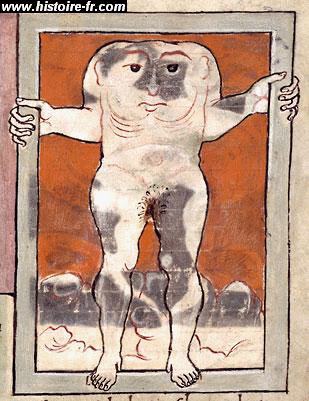
On the work front, however, things are really great. Only a week left in on-service (I needed to extend my January coverage so that I could take March break off with the boys), papers are coming along nicely, one got accepted (the blemmy will finally make an appearance in the genetic literature!), submitted another one and have two on the go. Love doing it again - I guess my writing should be in medicine and that's the end of that!
Saturday, January 30, 2010
Genetic Rounds.
I looked forward to reading Genetic Rounds by Robert Marion - it had such great reviews. I could not wait for my public library to get it and I ordered it through the university interlibrary loan. I read it very quickly, in one day – I can do that because I am able to skip the explanations of genetic concepts and basic science behind genetics: I, too, am a clinical geneticist.
I read it fast and I was appalled. I read it more carefully and not skipping the science bits. I was still appalled. Appalled by Marion’s arrogance and his self-aggrandizing, by his patronizing and paternalistic attitude toward patients.
This is a clinical geneticist who approaches a former patient at a social gathering some fifteen years after their initial encounter and without a preamble reminds her of probably the most painful and traumatic event in her and her family’s life – an amniocentesis that showed that their previous child had Down syndrome. And he does that in the presence of their second child who is there to receive a community merit award. How dare he!
This is clinical geneticist who diagnoses a baby with Down syndrome “without looking at his face, [just] seeing his back.” This is a man who has no doubt that a child with “microcephaly, sloping forehead, microphthalmia, beaked nose, low-set malformed ears, [and] polydactyly” has trisomy 13 and is willing to write that in the chart so that a DNR order can be considered; after finding cutaneous aplasia at the occiput he says “we’ll do chromosomes anyway, but there is no doubt about it. The baby’s definitely has trisomy 13.” Has he not heard of pseudo-trisomy 13 syndrome? What about Smith-Lemli-Opitz syndrome? This is a physician who “surprises” his colleagues by asking whether a mother of a child with sacral agenesis (which he diagnoses without radiographs) has diabetes mellitus. A man who at a glace diagnoses a variety of mucopolysaccharidosis – he is sure that a boy walking down the hall has Hunter syndrome (I happen to know mucopolysaccharidoses better than an average geneticist; I know that the coarse features are very characteristic, but I also know that a coarse-looking three year old boy can have either Hurler or Hunter syndrome, and I would not diagnose either unless I kneel down to his level and look in his eyes). And he “knows” that that child whom he later diagnoses with great aplomb as having hypohidrotic ectodermal dysplasia has “a neurodegenerative condition.[…] I knew he did; I was sure he did.” When he changes his diagnosis he states that after all, “you can tell that someone has HED from across the room.” In a case of a girl with neonatal Marfan syndrome “although she was only a few hours old and knew nothing about her family history (sic!), [he] was willing to bet that this baby had Marfan syndrome.”
His diagnostic acumen extends beyond mere genetics, though. He knows “immediately” that a child with Down syndrome has leukemia, because the blood flowing out of his vein has the “consistency and appearance of dilute cherry KoolAid.”
After he makes his diagnoses he “[goes] through the exams anyway”, even if “the rest of the exam [is] really unnecessary”. And he delivers his bad news to new parents after “hoisting [himself] up […] on the windowsill”.
He is skilled in projecting the air of faux humility when it suits him. The only reason why he was the only physician in the multitudes who had assessed a mother and daughter with a puzzling and chronic history to diagnose the two with acute intermittent porphyria was because he had "just written a book" on the role that genetics played in the history of United States.
And the tears. He has tears in his eyes so frequently that it is a miracle that the man can see straight. He cries when he dispenses his words of wisdom; he cries with the parents, alongside nurses caring for his patients, alone in the office and in the car driving to and from the various hospitals where he is on staff, before, during and after the funerals he attends. The book is downright soggy!
With one exception, I have had experience with the same diagnoses as he presents. I have told parents that their child had Down syndrome, or trisomy 13, or hypohidrotic ectodermal dysplasia, or Bardet-Biedl syndrome (except I have never told a “best friend” that his child had a genetic condition that he should attend to). As I read his essays hair rose on the nape of my neck and bile rose to my throat. I was angered by the contrast between the day to day care that I provide to my patients and their families and his blatant disregard for patient’s well-being at the expense of stroking his ego. I was angry because he and his attitude give clinical geneticists a bad name, and because he is published and regarded as an expert in the field and a great author. A reputation his works do not deserve.
I read it fast and I was appalled. I read it more carefully and not skipping the science bits. I was still appalled. Appalled by Marion’s arrogance and his self-aggrandizing, by his patronizing and paternalistic attitude toward patients.
This is a clinical geneticist who approaches a former patient at a social gathering some fifteen years after their initial encounter and without a preamble reminds her of probably the most painful and traumatic event in her and her family’s life – an amniocentesis that showed that their previous child had Down syndrome. And he does that in the presence of their second child who is there to receive a community merit award. How dare he!
This is clinical geneticist who diagnoses a baby with Down syndrome “without looking at his face, [just] seeing his back.” This is a man who has no doubt that a child with “microcephaly, sloping forehead, microphthalmia, beaked nose, low-set malformed ears, [and] polydactyly” has trisomy 13 and is willing to write that in the chart so that a DNR order can be considered; after finding cutaneous aplasia at the occiput he says “we’ll do chromosomes anyway, but there is no doubt about it. The baby’s definitely has trisomy 13.” Has he not heard of pseudo-trisomy 13 syndrome? What about Smith-Lemli-Opitz syndrome? This is a physician who “surprises” his colleagues by asking whether a mother of a child with sacral agenesis (which he diagnoses without radiographs) has diabetes mellitus. A man who at a glace diagnoses a variety of mucopolysaccharidosis – he is sure that a boy walking down the hall has Hunter syndrome (I happen to know mucopolysaccharidoses better than an average geneticist; I know that the coarse features are very characteristic, but I also know that a coarse-looking three year old boy can have either Hurler or Hunter syndrome, and I would not diagnose either unless I kneel down to his level and look in his eyes). And he “knows” that that child whom he later diagnoses with great aplomb as having hypohidrotic ectodermal dysplasia has “a neurodegenerative condition.[…] I knew he did; I was sure he did.” When he changes his diagnosis he states that after all, “you can tell that someone has HED from across the room.” In a case of a girl with neonatal Marfan syndrome “although she was only a few hours old and knew nothing about her family history (sic!), [he] was willing to bet that this baby had Marfan syndrome.”
His diagnostic acumen extends beyond mere genetics, though. He knows “immediately” that a child with Down syndrome has leukemia, because the blood flowing out of his vein has the “consistency and appearance of dilute cherry KoolAid.”
After he makes his diagnoses he “[goes] through the exams anyway”, even if “the rest of the exam [is] really unnecessary”. And he delivers his bad news to new parents after “hoisting [himself] up […] on the windowsill”.
He is skilled in projecting the air of faux humility when it suits him. The only reason why he was the only physician in the multitudes who had assessed a mother and daughter with a puzzling and chronic history to diagnose the two with acute intermittent porphyria was because he had "just written a book" on the role that genetics played in the history of United States.
And the tears. He has tears in his eyes so frequently that it is a miracle that the man can see straight. He cries when he dispenses his words of wisdom; he cries with the parents, alongside nurses caring for his patients, alone in the office and in the car driving to and from the various hospitals where he is on staff, before, during and after the funerals he attends. The book is downright soggy!
With one exception, I have had experience with the same diagnoses as he presents. I have told parents that their child had Down syndrome, or trisomy 13, or hypohidrotic ectodermal dysplasia, or Bardet-Biedl syndrome (except I have never told a “best friend” that his child had a genetic condition that he should attend to). As I read his essays hair rose on the nape of my neck and bile rose to my throat. I was angered by the contrast between the day to day care that I provide to my patients and their families and his blatant disregard for patient’s well-being at the expense of stroking his ego. I was angry because he and his attitude give clinical geneticists a bad name, and because he is published and regarded as an expert in the field and a great author. A reputation his works do not deserve.
Subscribe to:
Posts (Atom)